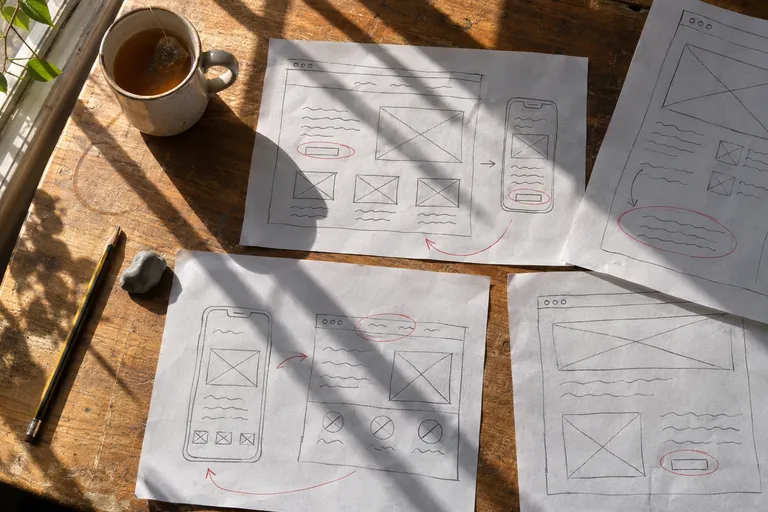
Most visitors to a service business site arrive on a phone, often in between other things, and want to know what you do, whether you do it for people like them and how to reach you. Those questions shape how we approach web design in Singapore. We plan the structure and draft the words at the same time as the visual design so the answers are easy to find, and we start from the phone layout.
What web design in Singapore should cover
A good design brief covers four things, and the look is only one of them.
- Structure: which pages exist, what each one is for and how people move between them.
- Copy: the words on each page, written around what the customer needs to know.
- Visual design: type, colour, layout and imagery that make the copy easy to read and the business easy to recognise.
- Mobile behaviour: how every page works on a narrow screen when it's being used with a thumb.
Designed separately, these give you a handsome site that says little, or clear words in a layout that buries them. We work on all four at once, so the designs you review already have draft copy in them. The process page walks through each stage.
Page structure
Most visitors arrive with a short list of questions. Take a physiotherapy clinic. Someone with a sore knee wants to know whether you treat knees, who will see them, where you are, whether there is parking or an MRT station nearby, and how to book. If those answers sit in five different places, plenty of people give up and try the next result.
We start by mapping questions to pages:
- List what customers ask before they commit, from your enquiry inbox and your front desk.
- Group the questions into pages, one job per page.
- Decide what each page should ask the visitor to do next.
Usually that means a separate page for each main service, an about page that introduces the people involved, and a way to get in touch that is never more than a tap away. Our guide to the pages a small business website needs goes deeper, and our page on clinic website design shows how this plays out in healthcare.
Writing the copy alongside the layout
A layout that looks balanced with three lines of placeholder text can fall apart when the real service description runs to twelve lines, or to two. We draft the copy alongside the layout so the design is built around the words it will carry.
The copy itself has to be specific. A homeowner learns nothing from "We provide comprehensive renovation solutions". "We renovate HDB flats and condos, from layout planning to handover, and manage the contractors for you" answers three questions in one sentence. Our guide to website copywriting for service businesses covers how we approach it.
Designing for phones first
Google uses the mobile version of a site's content for indexing and ranking, according to its mobile-first indexing documentation. That makes the phone layout the main version of the site. If something is left out of the mobile layout to save space, Google may never see it.
In practice we design for the phone first, then give larger screens more room:
- Navigation that suits a thumb, with the main action always within reach.
- Buttons and links large enough to tap. WCAG, the W3C's accessibility guidelines, sets a minimum target size of 24 by 24 CSS pixels with some exceptions, and we treat that number as the floor.
- Contact options that match how your customers already reach you, such as a WhatsApp link or a tap-to-call number, placed where people look for them.
- Price lists, timetables and schedules that stay readable without sideways scrolling.
Visual design and photography
We set a type scale, a colour palette and a layout grid that work across every page, so a page added next year still looks like it belongs. We also agree a direction for photography. Photos of your own team and premises usually do more for trust than stock images of handshakes.
If your logo, colours and fonts are settled, we design within them. If they are thin or inconsistent, it may be worth doing brand identity design first or alongside, so the website and everything you print and post share one system.
Moving from design to build
Design is finished when the pages read right and you are happy with how they look. The build then turns them into a fast, accessible site, which our website development page describes. The search groundwork described on our SEO services page is part of the build from the start.
If you are comparing studios, our guide to choosing a web design agency lists the questions worth asking anyone, including us. The guide to what a website costs in Singapore explains what goes into a design quote, and when you'd like to talk about your own site, the contact page has our email.