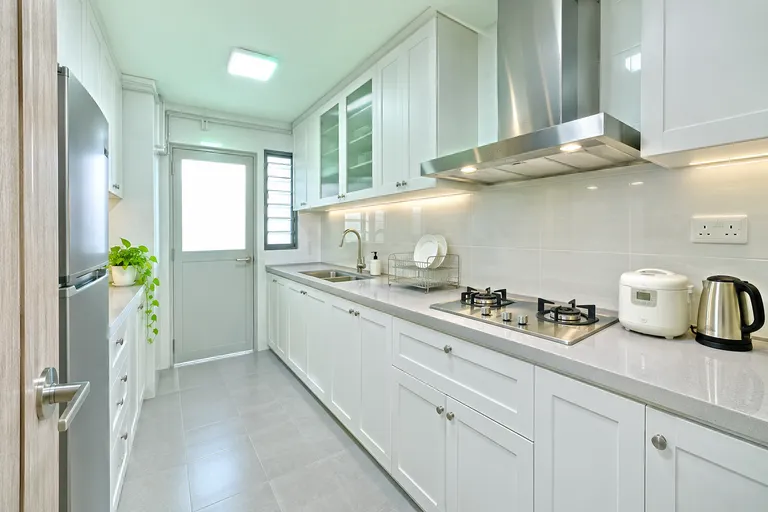
Homeowners judge an interior design website in Singapore by whether they can picture their own home in your work. People shortlisting a designer scroll through projects on a phone, often comparing several firms at once, and they look for homes like theirs, such as a 4-room resale HDB flat or a landed terrace. Strong photography organised by project type does most of the work. The rest of the site has to explain your process and show the credentials homeowners check before they pay a deposit.
Project pages
A single grid of 60 photographs makes every project blur into the next. Give each project its own page with:
- the property type and area, such as "4-room HDB resale, Punggol" or "3-bedroom condo, River Valley"
- the brief: who lives there and what they needed
- the main decisions, such as a wall taken out, storage built in or a kitchen opened up
- a full set of photographs, from wide shots of each room to close-ups of joinery and finishes
- the style in a few words, linked to other projects in the same style
A project page gives search engines something to read and gives a homeowner something to send their partner.
Organising an interior design website in Singapore by property type and style
Homeowners rarely search for "residential interior design". They search for things like "BTO interior design", "condo renovation" or "Japandi interior Singapore". Organise the portfolio along the same lines:
| Browse by | Examples |
|---|---|
| property type | new BTO, resale HDB, condo, landed, commercial |
| style | minimalist, Japandi, industrial, modern contemporary |
| scope | full renovation, kitchen and bathrooms, carpentry only |
Each of these can work as a filter, and the most important ones deserve landing pages of their own, with a short introduction and the matching projects. A BTO page can speak to key collection timing and the constraints of a new flat; a landed page can talk about planning across several storeys. Pages built around searches like these are where SEO for a design firm starts. If you focus on particular estates, our local SEO guide explains how location pages and your Google Business Profile fit together.
Project photography
The photographs carry most of the site, so plan the shoot with the website in mind:
- shoot finished, styled rooms in daylight, and reshoot older projects that undersell the work
- keep colour and white balance consistent within a project, so it reads as one home
- include vertical crops, since many visitors will look on a phone
- caption the details that show craft: a hidden door, a raised platform bed, a full-height shoe cabinet
Large photographs are also the usual reason design sites load slowly. Images should be resized, compressed, served in modern formats and loaded only as people scroll to them. Our guide to Core Web Vitals explains how speed is measured, and website development planned around images keeps a portfolio fast as it grows.
If many of your finished projects were never photographed well, plan the reshoot before the site. The photographs decide how project pages are laid out and how many can go live at launch, and our guide to what a website costs in Singapore explains how copy and photography affect a quote.
Explaining the renovation process
A renovation is a large, unfamiliar purchase, and much of the worry is about what happens after the deposit. A process page that sets out each stage answers a lot of it before the first meeting:
- first consultation and site visit, and what to prepare (floor plan, budget range, must-haves)
- design concept and layout, with how many rounds of revisions are included
- an itemised quotation that can be compared line by line
- approvals and permits, where the works need them
- works on site: who the homeowner's contact is and how progress is reported
- handover, defect checks and what happens if something goes wrong later
Describe your own stages and the timings you can keep to, because homeowners will hold you to them.
Licensing and accreditation
Credentials matter more in renovation than in most purchases, because so much money changes hands before work starts. Show the ones you hold, accurately, and help people verify them.
HDB's Directory of Renovation Contractors. HDB states that contractors must be listed in its Directory of Renovation Contractors before they can carry out renovations in HDB flats. If your firm is listed, say so and use your company name exactly as it appears in the directory. If you work through listed contractors instead, explain that arrangement on the site, and make sure nothing implies a listing you don't hold.
CaseTrust. The Consumers Association of Singapore (CASE) runs CaseTrust accreditation for renovation businesses, with requirements covering a standard renovation contract, deposit protection and dispute resolution. Accredited businesses may display the CaseTrust logo, and CASE keeps a list of accredited businesses that homeowners can search. Show the mark only while your accreditation is current, and link to CASE so people can check.
This is general information, not legal advice. Confirm current requirements with HDB and CASE.